Last Updated: 16 May 2025
Source: Statifacts


Share



The global canned tuna market size was evaluated at USD 33.41 billion in 2024 and is expected to grow around USD 45.17 billion by 2034, registering a CAGR of 3.06% from 2025 to 2034.
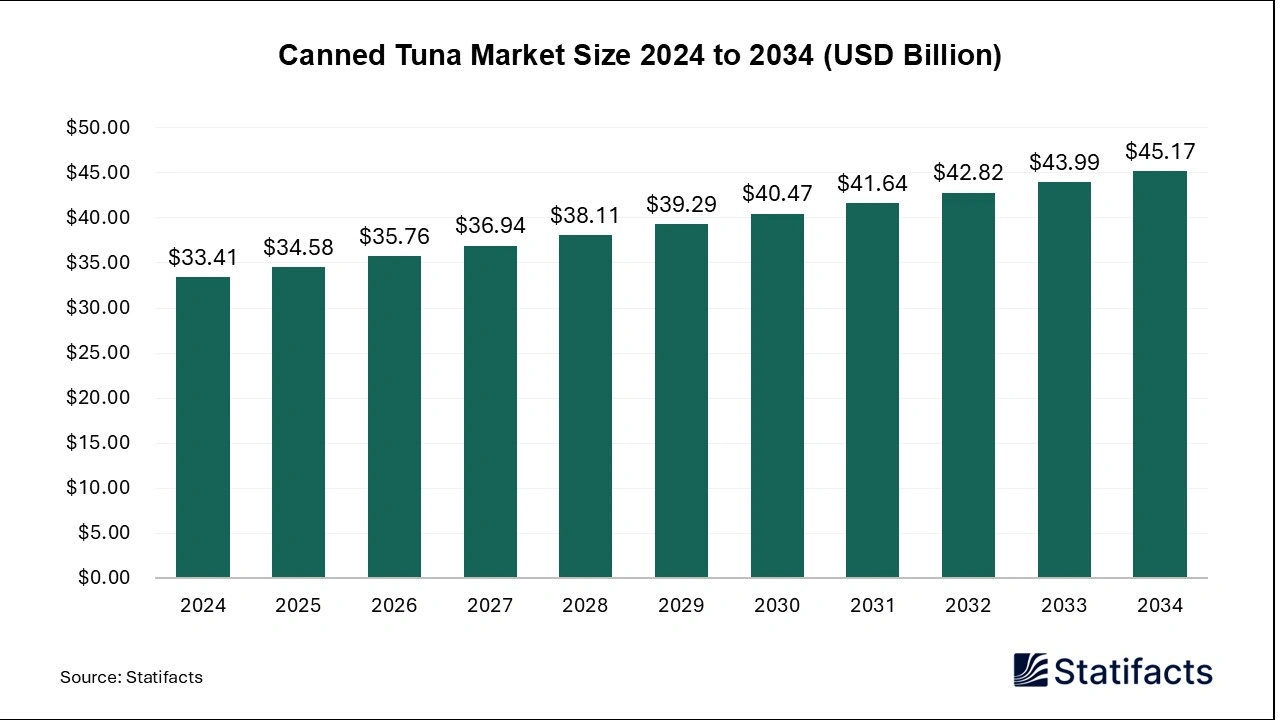
| Industry Worth | Details |
| Market Size in 2025 | USD 34.58 Billion |
| Market Size by 2034 | USD 45.17 Billion |
| Market Growth Rate from 2025 to 2034 | CAGR of 3.06% |
Introduction Canned tuna is a shelf-stable seafood product made from processed and preserved tuna fish, typically skipjack, yellowfin, or albacore. It is widely available in water, oil, or flavored variants and consumed directly or used in a variety of dishes like salads, sandwiches, and casseroles. Rich in protein and omega-3 fatty acids, canned tuna offers a convenient, nutritious meal solution with a long shelf life. Its portability, affordability, and minimal preparation needs have made it a staple in households, restaurants, and institutional food services globally.
The canned tuna market serves a broad range of sectors, including retail food service, healthcare, and education institutions, as well as emergency food supply chains. Rising global demand for convenient protein-rich foods is expanding the market footprint. The product is also widely used in ready-to-eat packaged meals, which contributes to its integration into the growing processed and convenience food industries.
Canned Tuna Market: Stats and Figures In 2022, researchers at Egypt’s Assuit University compared canned tuna types, including chunks, solid, and crumbled tuna. Crumbled tuna showed the highest pH, fat, energy, and cholesterol. While solid tuna had the lowest mean values for moisture, fat, and pH, protein and ash were observed in crumbled tuna samples.
“We are the biggest tuna exporter of southern Bluefin tuna and I think of all fish into China now,” said Mr.Stehr. he emphasized the company’s plans to expand its presence in China, stating, “we are looking at 40-50 tonnes a week, every week. China is the market for the future.”
“We are making this product because we own the boats. We catch the fish. We are using Australian olive oil that we have sourced…we are trying to bring something truly sustainable, and it’s super yummy.” Ms. Walker said, highlighting their commitment to sustainability and quality in their new line of preserved tuna products.
Europe
In 2024, Europe led the global canned tuna market, which is capturing a substantial 41.65% share. European consumers increasingly prefer tuna for its high protein and omega-3 fatty acid content like aligning with health and wellness trends. A Growing consciousness of sustainable and ethical fishing practices influences purchasing decisions, with consumers favoring brands that adhere to these standards.
The Middle East and Africa region is set to see the fastest growth in the canned tuna market over the forecast period. Urban populations such as Egypt’s are steadily increasing, leading to higher demand for convenient and easy-to-prepare food options like canned tuna. Countries like the United Arab Emirates, Saudi Arabia, and Kuwait are witnessing a surge in business and tourism. There is high demand in the food sector, and in turn, for canned seafood products. An increasing focus on healthy diets is driving consumers towards protein-rich foods, with canned tuna being a good choice due to its nutritional benefits and long shelf life.
Spain
In Europe, Spain is a major consumer of the canned tuna industry. The country is responsible for over 70% of the canned tuna processed in the European Union, making it one of the world’s leading producers. Spain boasts advanced processing facilities that assure high-quality production standards. A significant portion of Spain’s canned tuna is exported, catering to global demand and reinforcing its position in the international market. Spanish procedures are increasingly adopting sustainable fishing practices, aligning with global environmental standards and consumer expectations.
The canned tuna market is semi-fragmented, which is characterized by a mix of multinational corporations and regional players. While a few dominant companies hold significant market shares, numerous local brands contribute to the market’s diversity, fostering healthy competition.
The Union is a global leader in the seafood industry, offering a wide range of products, including canned tuna under brands like Chicken of the Sea and John West. Operating in over 100 countries, the company emphasizes sustainability and innovation, investing in research to improve fishing practices and product quality.
Bumble Bee Foods is one of North America’s largest branded seafood companies, known for its canned tuna, salmon, and other seafood products. The company operates primarily in the U.S. and Canada, focusing on sustainability and transparency in its supply chain.
Century Pacific is a leading food company in the Philippines with a strong presence in canned tuna through its Century Tuna brand. The company exports to various countries, offering a range of products that cater to health-conscious consumers.
Published by Vidyesh Swar





