

Share


Asia Pacific Vehicle-to-Grid Technology Market (By Component Type: Smart Meters, Electric Vehicle Supply Equipment (EVSE), Software, Home Energy Management (HEM); By Application Type: Battery Electric Vehicles (BEVs), Fuel Cell Vehicles (FCVs), Plug-in Hybrid Electric Vehicles (PHEVs)) Industry Size, Share, Growth, Trends 2026 to 2035

The Europe vehicle-to-grid (V2G) technology market surpassed USD 2,197 million in 2025 and is expected to reach USD 28,935 million by 2035, accelerating at a 29.41% CAGR driven by EV adoption and smart energy infrastructure advancements.
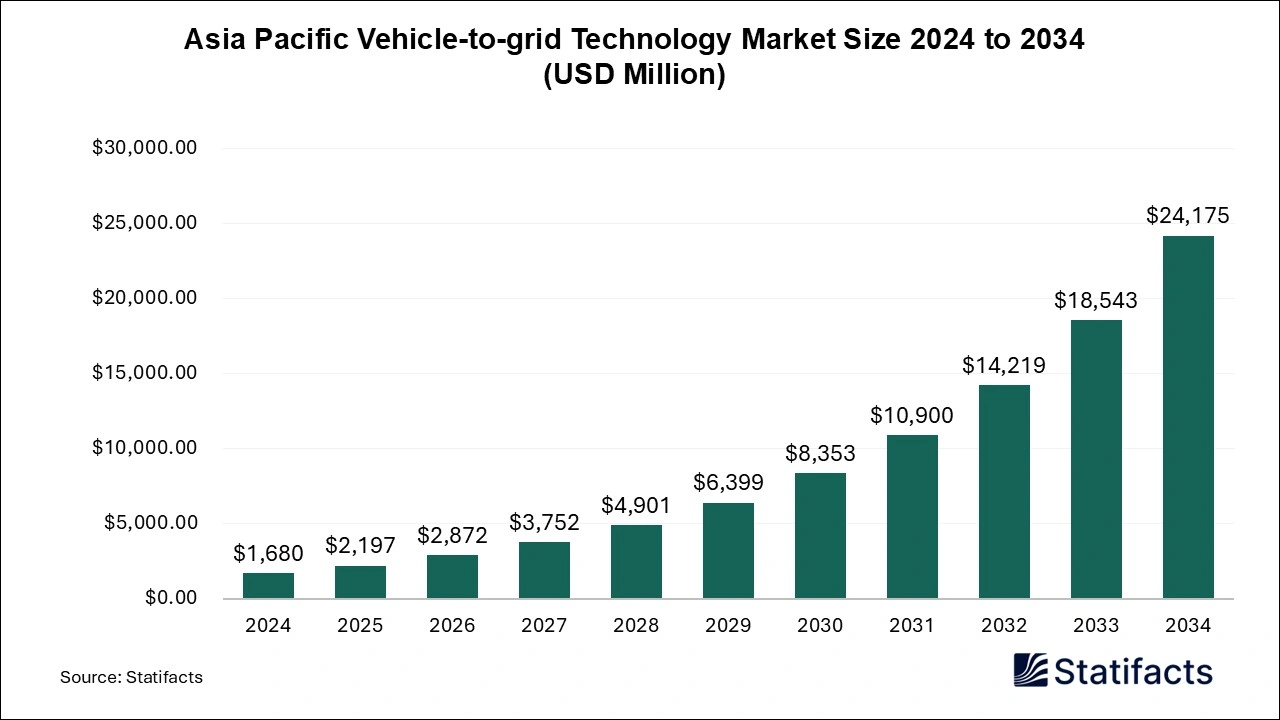
| Reports Attributes | Statistics |
| Market Size in 2025 | USD 2,197 Million |
| Market Size in 2026 | USD 2,872 Million |
| Market Size in 2032 | USD 14,219 Million |
| Market Size by 2035 | USD 28,935 Million |
| CAGR 2026 to 2035 | 29.41% |
| Base Year | 2025 |
| Forecast Period | 2026 to 2035 |
The Asia Pacific vehicle-to-grid technology market is expanding rapidly, driven by the region's dominance in electric vehicle production. Vehicle-to-grid (V2G) is the use of EVs to store energy and return it to the grid when needed. The massive EV expansion is creating several opportunities to incorporate these technologies into mobile storage units. The government has also been highly focused on expanding its solar and wind energy projects, where V2G helps stabilize grid fluctuations and meet these projects' requirements. The region has also been experiencing significant urbanization, which is driving strong demand for energy storage.
The growth of V2G remains challenging in the Asia Pacific region due to a lack of unified standards, which create barriers to implementing these technologies across different communication systems, grid protocols, and more. The majority of the population in the region is unaware of the benefits of V2G, which also creates barriers to the growth of the Asia Pacific vehicle-to-grid technology market. In many underdeveloped areas, EV infrastructure is still limited, which would drive greater adoption of the technology.
The future landscape of the regional market is highly driven by increasing investments in renewable energy storage. Countries like Singapore and the Philippines are launching several projects to advance sustainable, cost-effective energy storage in the region. Technological advancements are enabling bidirectional charging, boosting the adoption of Vehicle-to-Grid (V2G) technology. The growing business case for EVs is also driving the adoption of EV buses, vans, and other fleets to support a sustainable future by reducing carbon footprints. Moreover, the rise of virtual power plants is also supporting the management of energy supply during peak requirements.
The integration of technologies such as artificial intelligence and machine learning strongly supports growth by analyzing electricity demand and usage patterns. The constant focus on renewable energy also supports companies in implementing these technologies to predict renewable output and stabilize grids during supply. The Asia Pacific vehicle-to-grid technology market is expected to integrate AI to optimize battery health in harsh environments, protecting them from degradation, heat generation, and other factors. The commercialization of EVs will also integrate AI and ML to improve fleet output.
China is the dominant player in the market due to its largest global EV manufacturing base. The IEA data shows that China leads the world in EV manufacturing, accounting for around 70% of global production, helping make V2G more reliable through futuristic plans. The Asia Pacific vehicle-to-grid technology market is accelerating significantly, driven by the increasing government policies towards renewable energy and smart grid development. According to the IEA, in 2024, China’s clean energy investment was around USD 625 billion, almost double that of 2015. The country also achieved its 2030 wind and solar capacity target six years ahead in 2024.
Japan is a crucial player in the Asia Pacific vehicle-to-grid technology market, with companies like Nissan supporting bidirectional charging. Japan has a strong electric vehicle ecosystem and a long history of grid innovation, which makes it easier to test and deploy V2G technologies across residential and commercial settings. Utilities and automakers also work closely to ensure compatibility with national grid standards.
The company announced the launch of a new affordable bidirectional EV charger in 2026, which will help owners maximize energy use during peak demand. This solution allows households to discharge stored power back to the grid or support home energy needs during high-tariff periods, thereby improving cost savings and energy efficiency. Lower hardware costs are expected to accelerate consumer adoption.
| Segments | Shares (%) |
| Smart Meters | 15.03% |
| Electric Vehicle Supply Equipment (EVSE) | 30.03% |
| Software | 27.42% |
| Home Energy Management (HEM) | 27.52% |
| Segments | Shares (%) |
| Battery Electric Vehicles (BEVs) | 38.36% |
| Fuel Cell Vehicles (FCVs) | 31.59% |
| Plug-in Hybrid Electric Vehicles (PHEVs) | 30.05% |
Published by Ajit Bansod





