

Share


Asia Pacific Digital Health Market - (By Component: Software, Hardware, Services; By Technology: Telehealthcare, mHealth, Digital Health Systems, Health Analytics) Industry Size, Share, Growth, Trends 2026 to 2035.

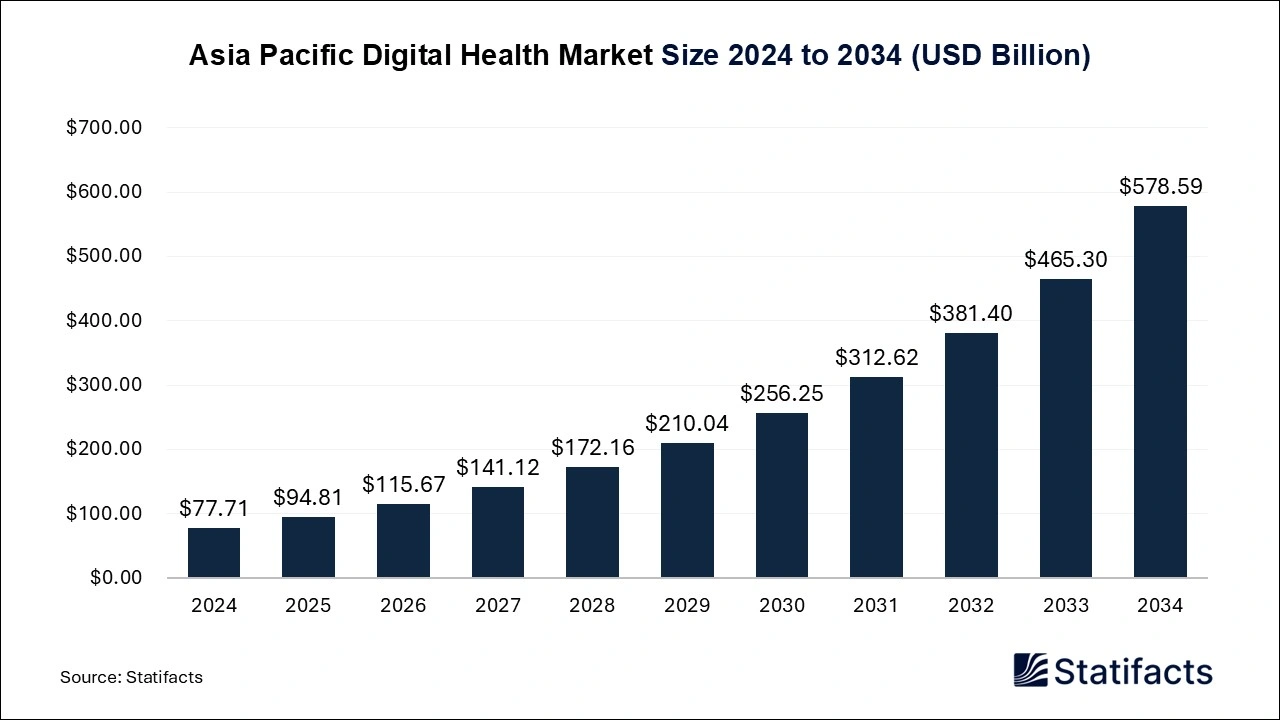
The Asia Pacific digital health market was valued at USD 94.81 Bn in 2025 and is projected to reach USD 672.29 bn by 2035, growing at a 21.64% CAGR. Expansion is fueled by rising smartphone adoption, telehealth demand, and government digital initiatives.
| Reports Attributes | Statistics |
| Market Size in 2025 | USD 94.81 Billion |
| Market Size in 2026 | USD 115.67 Billion |
| Market Size in 2032 | USD 381.4 Billion |
| Market Size by 2035 | USD 672.29 Billion |
| CAGR 2026 to 2035 | 21.64% |
| Base Year | 2025x |
| Forecast Period | 2026 to 2035 |
The Asia Pacific digital health market is expanding at a significant pace, driven by the region's largest patient population, many of whom face obesity, diabetes, COPD, and other conditions. As a result, this creates a significant demand for digital health solutions that can reach the majority of semi-urban and rural areas in the country. The governments in the region are also focusing on investments that enable digital solutions to enable access, monitoring, and long-term patient management at lower costs. Asian countries are also among the fastest-growing in urbanization, which promotes huge demand for smartphones and wearables that support telehealth. Additionally, the region's cost-effective deployment of digital technologies drives a large startup market.
The broader healthcare sector in the Asia Pacific faces certain regulatory challenges, with some countries having mature telehealth frameworks and others still lacking basic rules for remote monitoring and related parameters. This can be a constraint for some companies aiming to invest in digital health, particularly in semi-urban and rural areas with low awareness. These areas create a digital divide that can limit the reach of mobile phones and wearables.
The increasing digitization of e-health, such as EHR adoption, telehealth reimbursement, digital health platforms, and more, is expected to be a game-changing factor for digital health in the region. The increasing affordability of wearables and smartphones is also expected to drive a large presence of these devices in healthcare. Manufacturers in the industry are investing in remote patient monitoring (RPM) devices for chronic diseases, with a focus on diabetes, heart failure, and COPD. The rising focus on digital therapeutics for localized areas is expected to drive further growth in disease prevention by leveraging cultural contexts and local language support for individuals. The emergence of DME rental, pharmacy delivery, and teleconsults is expected to create significant opportunities in the coming years.
Healthcare in the Asia Pacific is rapidly growing due to the low-cost deployment of technologies like artificial intelligence (AI) and machine learning that analyze multiple parameters to improve digital healthcare outcomes. The integration into the clinical workflow focuses on analyzing data for accuracy and image interpretation, thereby improving diagnostic outcomes. The inclusion of AI-powered chatbots and CDS engines is helping to manage the workforce and finances in these operations. ML is being used in personalized solutions, such as messages, dosage reminders, lifestyle nudges, and other approaches, to help maintain patient engagement in digital health.
China stands as the dominant country in the Asia-Pacific digital health market, driven by its larger middle class, which has easy access to smartphones and wearable devices, thereby fueling the market for health platforms. Private firms are also keen to invest in telemedicine, online pharmacy, and AI to support their operations. Government support for electronic medical records, public programs, and other initiatives is driving a significant demand in the digital health market. The country has been a major leader in AI, managing low-cost implementation that generates higher revenue.
India is one of the most opportunistic countries due to increasing awareness of telehealth and medicine in semi-urban areas, supported by private and government initiatives. The RPM and AI inclusion is being deployed at lower costs, which can drive several investments in the coming years. The growing focus on digital health platforms, such as eSangeeevani telehealth rollouts, digital health IDs, and more, will drive future business.
| Regions | Shares (%) |
| Software | 37.45% |
| Hardware | 28.31% |
| Services | 34.24% |
| Segments | Shares (%) |
| Digital Health Systems: | 19.87% |
| mHealth: | 25.13% |
| Telehealthcare | 30.45% |
| Health Analytics | 24.55% |
Published by Ajit Bansod





