

Share


Asia Pacific Corporate Wellness Market (By Service: Fitness, Health Risk Assessment, Health Screening, Smoking Cessation, Stress Management, Nutrition & Weight Management, Others; By Category: Psychological Therapists, Fitness & Nutrition Consultants, Organizations/Employers; By Delivery Model: Offsite, Onsite; By End-use: Large Scale Organizations, Medium Scale Organizations, Small Scale Organizations) Industry Size, Share, Growth, Trends 2026 to 2035

The Asia Pacific corporate wellness market exceeded USD 13.39 billion in 2025 and is forecast to reach about USD 28.52 billion by 2035, growing at a 7.85% CAGR, supported by rising workplace health initiatives and increasing employer focus on productivity and wellbeing.
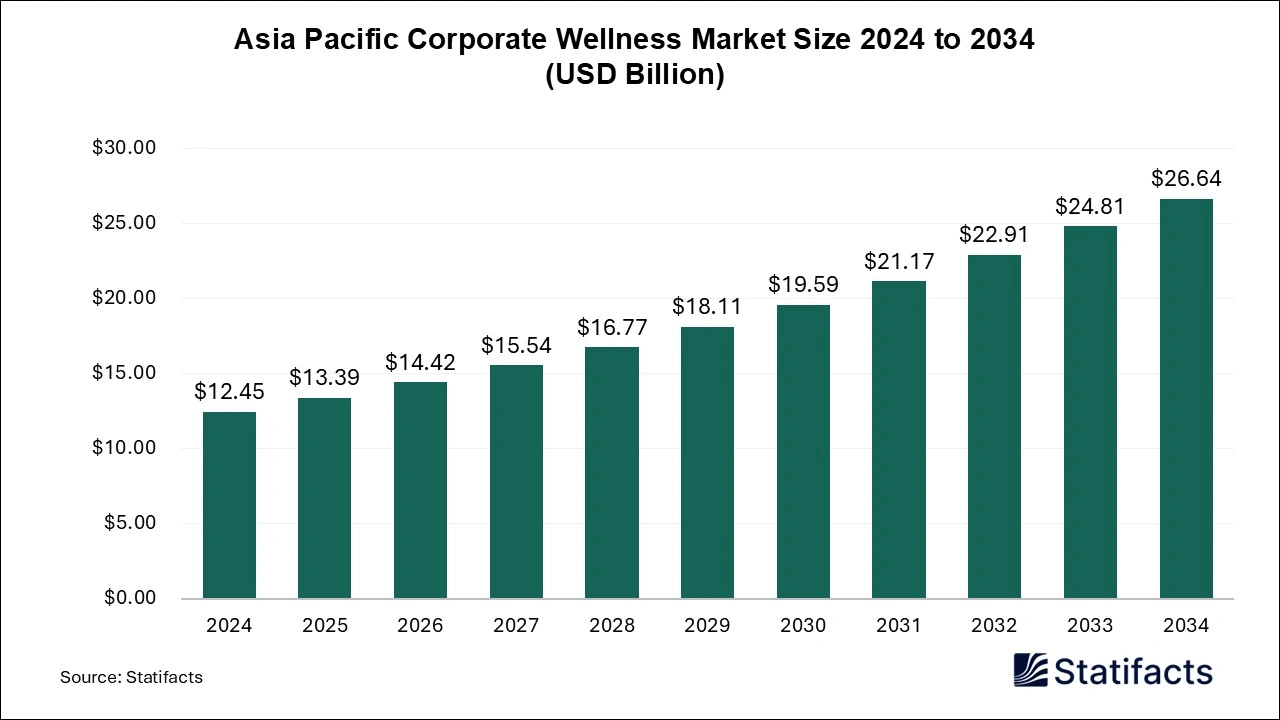
| Reports Attributes | Statistics |
| Market Size in 2025 | USD 13.39 Billion |
| Market Size in 2026 | USD 14.42 Billion |
| Market Size in 2032 | USD 22.91 Billion |
| Market Size by 2035 | USD 28.52 Billion |
| CAGR 2026 to 2035 | 7.85% |
| Base Year | 2025 |
| Forecast Period | 2026 to 2035 |
Demand is increasing because employers face rising productivity losses from chronic conditions and work-related stress, and many organisations are shifting from ad hoc programs toward integrated wellbeing strategies. The International Labour Organization in 2023 reported that psychosocial risks and workplace stress are major drivers of absenteeism and presenteeism in Asia Pacific, prompting companies to invest in mental health services, employee assistance programmes and resilience training. Large employers and multinational firms are expanding benefits to include preventive screenings, telemedicine access, and lifestyle coaching to reduce long-term healthcare costs.
Digital transformation is a second force boosting demand. Mobile health apps, telehealth consultations and wearable integrations make wellness programmes scalable across dispersed workforces in China, India, Southeast Asia and Australia. A 2021 review in Lancet Digital Health highlighted that digital interventions improve reach and engagement in workplace health programmes when combined with personalised coaching and incentives. The rapid rise of hybrid and remote work models is also increasing demand for virtual wellness offerings that support both physical and mental wellbeing outside the traditional office.
Despite momentum, the market faces barriers related to uneven regulatory frameworks and privacy concerns. Data protection laws vary widely across the region, creating uncertainty when employers use biometric data or mental health platforms. Employees may mistrust employer-led programmes if confidentiality is not assured. The Asia Pacific Economic Cooperation and national privacy agencies have emphasised stronger governance in recent years, but compliance complexity remains a deterrent in many markets.
Access and affordability also limit adoption in lower-income countries and small and medium enterprises. While multinational firms can implement advanced, AI-enabled wellness platforms, smaller employers in developing markets often lack budgets and digital infrastructure. The World Bank in 2022 noted that digital access and corporate capacity gaps persist in parts of South and Southeast Asia, which reduces programme penetration outside urban centres. Cultural stigma around mental health in several countries also inhibits uptake, requiring tailored education and localised programme design.
The region is diverse, with high-income markets such as Japan, Australia and South Korea leading in comprehensive wellness spend, integration of occupational health services and regulatory support for workplace mental health. These markets show high penetration of employee assistance programmes, subsidised counselling and advanced digital solutions. Governments and national health agencies in these economies increasingly promote workplace health guidelines and incentives to reduce chronic disease burden.
Fast-growing middle-income markets such as China and India offer the largest addressable populations and the fastest growth rates. Urban employers in these countries are rapidly adopting telehealth, digital coaching and biometric screening to attract talent and reduce absenteeism. Meanwhile, Southeast Asian economies show mixed adoption: large multinationals and urban employers drive innovation, while many SMEs lag due to cost and capability gaps. Regional development agencies and industry groups are expanding training and awareness initiatives to raise programme quality and coverage.
China’s market is expanding quickly as large enterprises and technology firms integrate corporate health platforms, telemedicine and onsite clinics. Government health strategy emphasising chronic disease management and the rise of health tech startups support rapid deployment of digital wellness solutions, especially in major cities.
India shows strong growth potential driven by a young but increasingly stressed workforce and rapid digital adoption. Large employers and IT firms lead with comprehensive wellness benefits, telehealth access and mental health programmes, while efforts continue to expand services to smaller firms and non-urban workers.
| Segments | Shares (%) |
| Fitness | 14.21% |
| Health Risk Assessment | 13.08% |
| Health Screening | 12.44% |
| Smoking Cessation | 13.89% |
| Stress Management | 13.55% |
| Nutrition & Weight Management | 16.07% |
| Others | 16.76% |
| Segments | Shares (%) |
| Psychological Therapists | 32.14% |
| Fitness & Nutrition Consultants | 31.09% |
| Organizations/Employers | 36.77% |
| Segments | Shares (%) |
| Offsite | 48.33% |
| Onsite | 51.67% |
| Segments | Shares (%) |
| Large Scale Organizations | 40.15% |
| Medium Scale Organizations | 28.74% |
| Small Scale Organizations | 31.11% |
Published by Ajit Bansod





