

Share


Asia Pacific Biofuels Market (By Fuel Type: Biodiesel, Ethanol; By Feedstock: Coarse Grains, Non-agri Feedstock, Biomass, Vegetable Oil, Sugar Crop, Jatropha, Others) Industry Size, Share, Growth, Trends 2026 to 2035

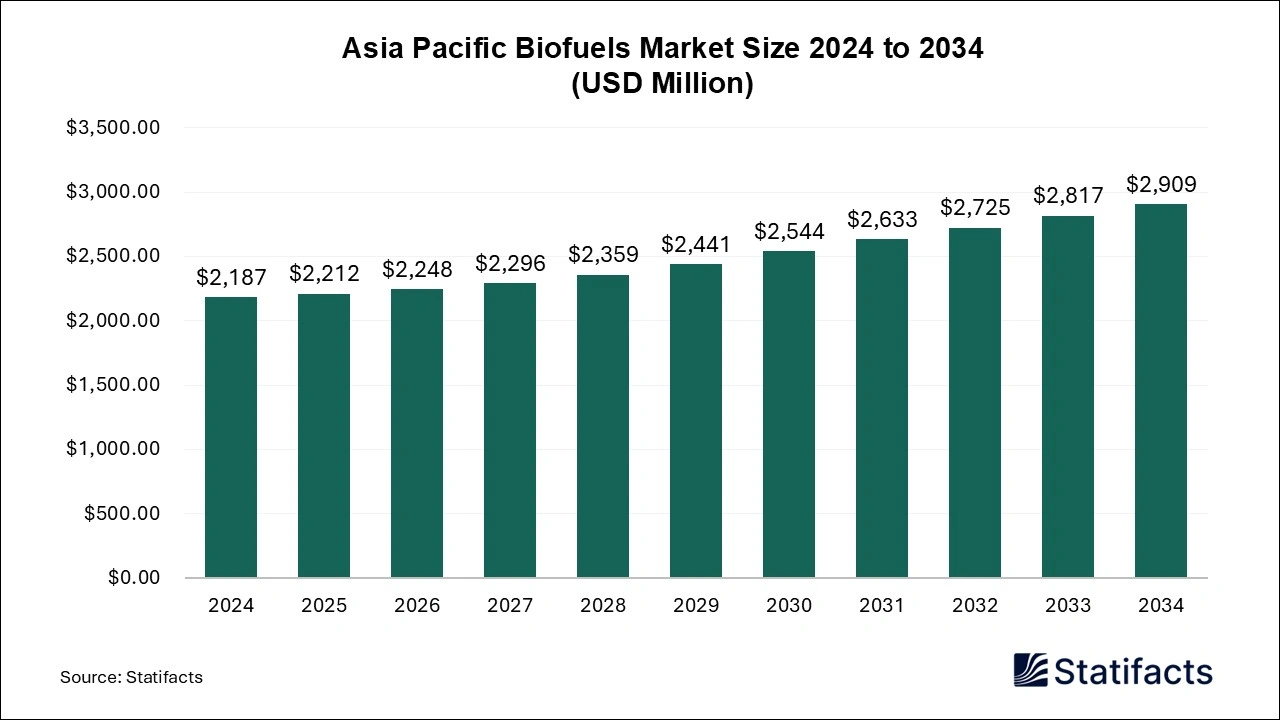
The Asia Pacific biofuels market was valued at USD 2,212 million in 2025 and is expected to reach nearly USD 3,001 million by 2035, expanding at a 26.04% CAGR, driven by rising clean energy adoption and government sustainability initiatives.
| Reports Attributes | Statistics |
| Market Size in 2025 | USD 2,212 Million |
| Market Size in 2026 | USD 2,248 Million |
| Market Size in 2032 | USD 2,725 Million |
| Market Size by 2035 | USD 3,001 Million |
| CAGR 2026 to 2035 | 26.04% |
| Base Year | 2025 |
| Forecast Period | 2026 to 2035 |
Demand is rising because countries across Asia Pacific are intensifying efforts to lower carbon emissions from transport and industry. Several nations have implemented or expanded ethanol and biodiesel blending mandates. India has accelerated its ethanol blending roadmap, while Indonesia and Malaysia have significantly increased biodiesel requirements. The region’s energy agencies emphasise biofuels as a key strategy for reducing dependence on imported fossil fuels and supporting rural economies through agricultural feedstock usage.
Another major driver is the region’s expanding transportation sector. Rapid urbanisation and population growth have increased the number of vehicles on the road, prompting governments to integrate low carbon alternatives. Sustainable aviation fuel adoption is also gaining momentum, as Asian airlines begin to commit to long-term emission reduction targets. Technological advances in converting agricultural residue, municipal waste and forestry biomass into advanced biofuels further support the market by reducing feedstock constraints and promoting circular-economy models.
Despite strong government support, the market faces challenges related to feedstock availability and competition with food supply. The Food and Agriculture Organization has noted that climate variability affects crop yields in several Asia Pacific countries, influencing feedstock supply for biodiesel and ethanol production. Rising prices of palm oil, sugarcane and other agricultural materials create volatility in production costs.
Infrastructure gaps present another obstacle. Many countries lack sufficient distribution networks for higher biofuel blends or have limited refinery capacity for advanced biofuels. Smaller economies struggle with financing large-scale biorefineries, and permitting processes can be complex. Concerns about land use change, especially in Southeast Asia, also influence international market perception and may affect export opportunities. Limited technical expertise and inconsistent policy implementation in some regions further slow adoption.
Asia Pacific is a highly diverse market. Southeast Asia leads in biodiesel production, driven by Indonesia and Malaysia’s strong mandates and large palm oil industries. These countries continue to expand biodiesel output while exploring advanced biofuel technologies. India is emerging as a major ethanol hub due to its aggressive blending roadmap and government support for sugarcane and grain-based ethanol plants.
Northeast Asia, including China, Japan and South Korea, is increasing focus on advanced biofuels and sustainable aviation fuel. These countries rely more on waste residues, used cooking oil and imported feedstocks due to limited domestic agricultural land. Australia is expanding biomass-based energy initiatives and investing in sustainable aviation fuel production through partnerships with industry and research institutions.
China’s market is growing as the country seeks to diversify its energy mix and reduce carbon emissions. The National Energy Administration has supported pilot programmes for ethanol and renewable diesel, with increased focus on waste-based and residue-based feedstocks. China is also investing in sustainable aviation fuel research and demonstration projects. Urban waste-to-biofuel initiatives are expanding as cities prioritise circular-economy solutions. Although large-scale national mandates have evolved gradually, regional and provincial programmes continue to drive steady market activity.
India represents one of the fastest-growing segments due to strong policy commitments and rising transport fuel demand. The Ministry of Petroleum and Natural Gas accelerated its ethanol blending targets and invested heavily in second-generation ethanol plants using agricultural residues such as rice straw and wheat straw. Biodiesel adoption is increasing in commercial fleets, and new public-private partnerships are expanding the availability of used cooking oil-based biodiesel. India’s emphasis on energy independence, rural income generation and carbon reduction supports sustained growth in biofuels infrastructure and innovation.
| Regions | Shares (%) |
| Biodiesel | 55.41% |
| Ethanol | 44.59% |
| Segments | Shares (%) |
| Coarse Grains | 19.81% |
| Non-agri Feedstock | 15.47% |
| Biomass | 14.96% |
| Vegetable oil | 11.89% |
| Sugar crop | 13.97% |
| Jatropha | 14.82% |
| Others | 9.08% |
Published by Vidyesh Swar





